By June Price, writing in
Jam Entertainment News,
May 14, 1993
One hardly expects a trip to the local music store to
change one's life, but that's exactly what happened
to John Mark Schilling. Schilling, who was in
search of guitar strings, remembers, "I walked in,
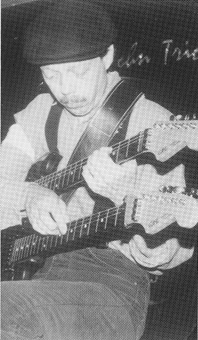
and there it was, on the counter." "It" was a double
neck guitar, custom built by Chris Lukasik, who
worked at the shop, to combine the best of the
Fender and Gibson sounds. Hooked, Schilling
walked out of the store with the double neck,
setting the path for what was to follow.   "I'd seen
Stanley Jordan playing one," recalls Schilling,
who's known to many in Central Florida for his
work with the Little John Trio, "but until I walked
into that store, I'd never seriously given any
thought to playing double neck." No wonder.
Requiring intense concentration and, in a sense, a
whole different set of muscles to master, the
double neck isn't for everyone.
    "The mental fatigue at first was incredible," says Schilling. But he persevered.
Although it's his double neck-tapping and sliding technique that have won him
attention from fans and record companies alike, Schilling's style, which is often
compared to Jordan's is not limited to tapping. Not only does he admit with a
laugh to occasionally picking up a standard issue guitar, but he's developed the
mental and physical dexterity to play chords on one neck while playing over that
chord on the other. That opens up a universe of sound and harmony. Sound
easy? Try it. He's also experimenting with the polytonality of the instrument,
which is mono, not stereo. Each neck, therefore, is set up differently, opening up
a wide range of possibilities.
 Of course, while it is the double neck that's attracted the most attention,
Schilling is hardly a one dimensional musician. Nor was the guitar always his
instrument of choice. "I started out playing the banjo," he says, "but somewhere
along the line, I guess when I was about nine, I fell in love with the guitar and
had to have one."
 And, unlike many young musicians, Schilling had the support of his family.
"Yeah, I guess you could say I come from a musical family," he says. "My father
played the piano, mostly Dixieland and swing, and there was always music in the
house." Although his father did the occasional gig on the side, he was not
impressed with the music business and, as a pianist, would have preferred to see
his son tinkling the ivories. "I think he was upset when I told him I wanted a
guitar," recalls Schilling, "but I also think he was impressed when I began to
show some ability."
 Growing up listening to a mixed bag of the likes of Fats Domino, Elvis, Hendrix,
and Miles Davis, Schilling started his career in a rock 'n' roll band. He was all of
twelve years old. "It wasn't really a group," he admits. "It was a duo." Even then
however, he was the main guitarist, a position he has held in most of the bands
he's played with.
 He almost made his big break in the Sixties. Approached by the band Mountain,
which some have called a rougher, louder version of Cream, Schilling spent some
time rehearsing and writing with the band but, unfortunately, things did not work
out. "It was close," he says, "but everything fell apart at the last minute.
 Some time after that, Schilling decided to pack up his bags and try his luck in
Florida, arriving in the late Sixties. Coming from New York, where there was
always work, the first few years were a period of adjustment for Schilling.
 "In all the time I played in New York," he notes, "I'd only been in three or four
bands but have played in , well, let's just say
a lot of bands in Florida." Asked
why, he recites reason that may sound familiar to long time Florida musicians,
most notably the lack of public support at the time for original bands and the
tendency of Florida clubs to hire bands for weekends rather than for the extended
gigs common in more metropolitan areas like New York. "It was a whole
different scene than what I was used to," he says.
 Interestingly enough, however, it's been only recently that Schilling has found
himself in the position of leadership in a band. "I've always been just 'one of the
guys,'" he says. The John Mark Schilling Trio, which features his son on drums,
is the first time he's been the one in the position of full leadership. Like many
musicians, Schilling finds that a double-edged sword. "Being you own boss has
its drawbacks," he points out. "Not only do other people have to depend on you,
but
you have to depend on you, and that's not always good." Asked for an
example, he gives one all too familiar to many musicians. "I'm not good at asking
people for money," he says, adding with a laugh, "but I'm getting better."
 Of course, given the interest that his album,
A Flower In Verdun, has attracted,
Schilling may not have to worry about that for long. Not only has he been written
up by Guitar Player magazine, one of the most respected music magazines in the
world, but several record companies have shown an interest in his unique style of
playing.
 "I'm sure I owe a lot of that to the double neck," he admits, "but there are still
things I want to work on." For instance, while he writes lyrics, he admits to
having written only about fifty complete songs, and is currently in search of a
compatible soul to write with. "Haven't met the right person yet," he says, "but
I'm looking."
 In the meantime, Schilling works on fine-tuning his double neck technique, and
the group plays whenever they can. Watching John Mark play, it's difficult to
believe at times that all the sounds one hears are coming from one guitar. More
incredibly, Schilling hopes to improve still more on his unique style. "I've only
begun to scratch the surface of what's possible with the double neck," he says.
"The possibilities are limitless."
 And - typical - despite the success of
A Flower In Verdun, Schilling is not 100%
satisfied with the release. "When you're recording," he explains, "you're so
emotionally tied up in what you're doing that sometimes what you think you hear
isn't what you're getting." As a result, he notes that he may rework
A Flower In
Verdun
, adding three new songs and then releasing it as a CD.
 Since he was once known as a rock 'n' roll guitarist, it seemed fair to ask
Schilling what brought him to major in his own particular brand of jazz and blues.
While reminding us that "I grew up listening to everything from Dixieland,
Be-bop, and Wes Montgomery, to Clapton and Hendrix, so it wasn't like I was
limited to one thing," he admits to another reason. Schilling notes that, quite
frankly, the club audiences for his music also played a role in his decision. "To be
honest," he says, "I was getting tired of playing the loud, noisy clubs where the
people there were there to be seen and heard, not to listen to the music. I love
rock 'n' roll - always have, always will - but there's just a certain something about
playing for a bit more sophisticated audience."
 Despite this, Schilling is reluctant to accept labels. "I'm a musician, not a jazz
musician," he says. With twenty-something years in the business, that's an
understandable sentiment. Schilling, who has shared the stage with the likes of
B.B. King, Patti LaBelle, Ramsey Lewis, Sam Cook, Kenny Rankin and Bela
Fleck, still practices daily and works to improve his playing.
 In the meantime, he's looking not only for that elusive "right one" to collaborate
with, but also for representation and a recording deal. "I think that's every artist's
ultimate dream," says Schilling. "You may make the music for yourself, but let's
be honest: the ultimate high is to know people are listening."
by Mike Varney, writing in Guitar Player
magazine.
 Born and raised in Chester, New York, John
began studying guitar at age 9 and developed his
style by playing rock, jazz, and country. Two
years ago he began experimenting with two necks
and developed a functional neck-tapping technique
that's inspired him to drop all other endeavors. On
his current live video he taps both fretboards at
once, playing simultaneously rhythm and solo
parts or harmony and contrapuntal lines. In a
concert setting, his vocals and use of conventional
electric guitar, acoustic guitar, and the double-neck
make for a very entertaining show. Highlights
include dual-neck interpretations of jazz and blues
standards, as well as contemporary and original
music.
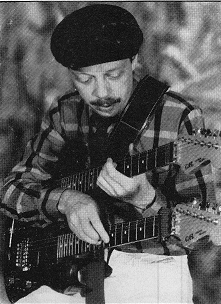
John feels that the potential of dual-neck guitar playing is nearly limitless, and his
pioneering effors should endear him to fans of Stanley Jordan and other music
lovers who appreciate technical innovation. Where some dual-=neck guitarists
sound like nothing more than two mediocre players jamming in a music store,
John's playing is rich in integrity and maturity and should help him gain a faithful
audience. His goals include obtaining a recording contract and taking the dual-neck
style into new musical areas with harmony and polychordism.


Credits